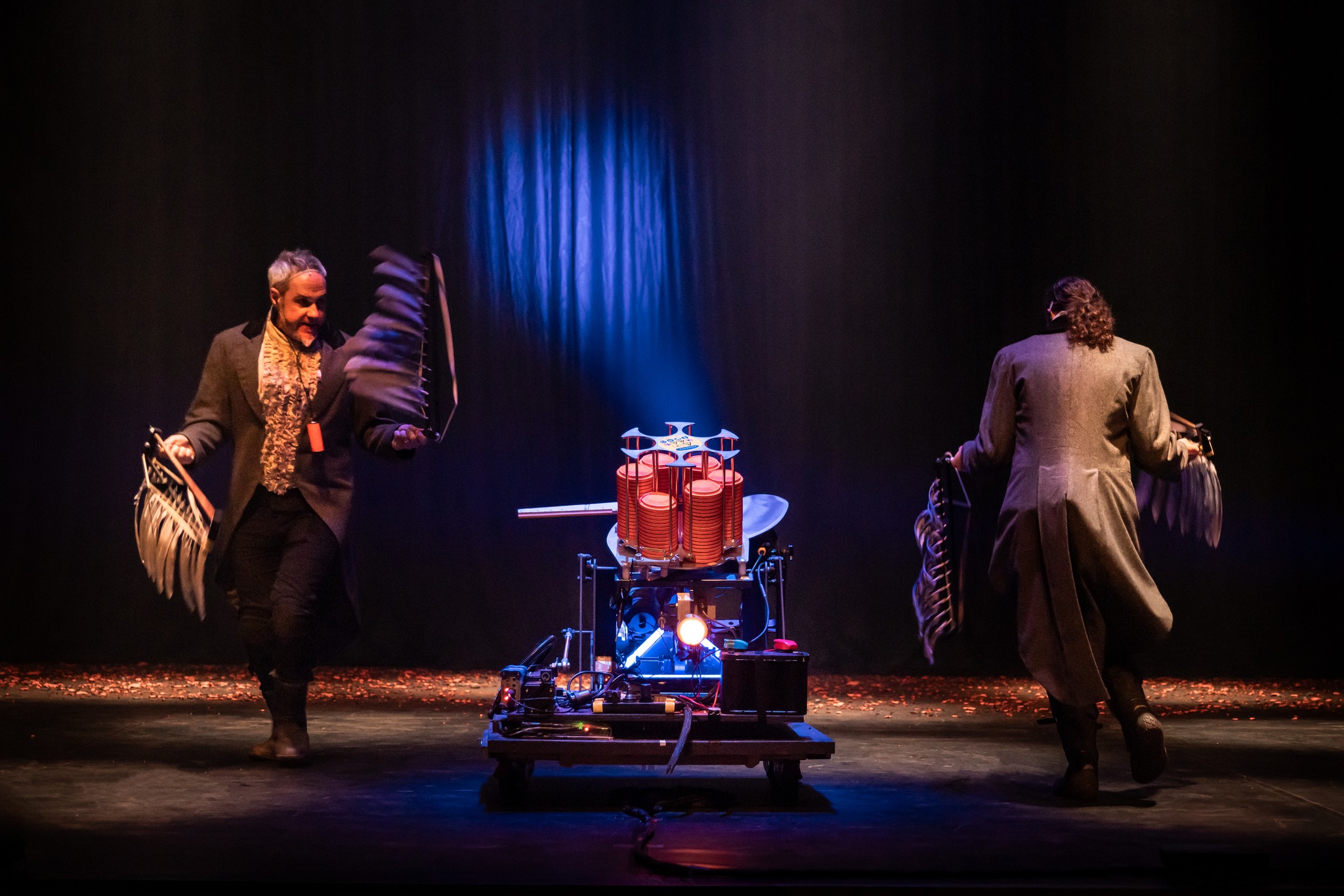
What do pigeons and percussionists have in common? More than you think, actually, as Speak Percussionists revealed during a mind-bending performance of “Pigeons” at the Melbourne Recital Centre on June 14.
“Pigeons” is the brainchild of Speak Percussion Director Eugene Ughetti. The idea for this creation, he explains in program notes, came from watching the trap machine used to launch clay pigeons in Olympic shotgun events. Intrigued by the sport’s spectacle and precision, but troubled by its violence and bloodthirsty origins, Ughetti felt impelled to explore “pigeon-human” relations – percussively.
For this theatrical event, the Melbourne Recital Centre stage is transformed into a pigeon-centred world; but in this performative world, normal relationships are inverted.
A giant orange disc is suspended from a metal frame by the side of the stage, with machines like generators set up near the front, stacked with small orange discs.
Silence reigns.
Ughetti and fellow percussionist, Kaylie Melville, dressed in tails with feathery vests, emerge from the wings (!). We can hear the click of their birds’ feet boots as they pick their way across the stage. Eventually they take flight; their “wings” – da Vinci-like feathery frames that the performers swing in varying rhythms, in and out of sync – create a trail of light and sound as they curl through the air.
Their destination is an “orchestrated birdcage”. As they settle on their perches – with plenty of thoughtful head-bobbing from Melville – our senses are activated by an ad hoc, highly theatrical symphony of sounds as they scrabble for seeds in the clay saucers, crack them open and toss them away, and strike the bird mirror and bell with their beaks and feathers. They bill and coo, making authentic-sounding pigeon calls – twelve types of pigeon calls are used – through delightful little orange beaks.
But it is not only the birdcage furnishings that have percussive qualities; the cage itself proves to be percussive, and Ughetti plays this giant metallic instrument by striking, vibrating and somehow manipulating vibrations from its frame.
The third scene is unveiled when Melville slowly unfurls curtains at the back of the stage to reveal a giant grid resembling a poker machine, arrayed with stylised images including a bird, a number (7) and a bell. The images within the pigeon-percussionists’ reach are explored, and it becomes apparent that each image has its own unique percussive qualities.
At this point, one by one the three trap machines make their presence felt. Tension mounts as clay discs begin to hurtle through the air and smash against the display, revealing the distinctive timbre of the wooden and metal images suspended on the grid. The trap machines are relentless and noisy. They sound like overwrought generators as they rev up and launch their clay discs, and the pulsing vibrations become almost overwhelming. The two birds have to take cover as the three trap machines send volley after volley high across the stage, but the music continues, with the two human pigeon-percussionists tapping frantically on the lower bank of images. It’s intense. The hall is vibrating with violent sounds, and the stage is blood-red.
It feels like a massacre, but it’s framed like a game. This is one of many paradoxes Ughetti draws out in this complex piece of musical theatre. Ughetti presents the audience with a dual perspective on the relationship between pigeons and humans, using the trap machine to trigger a power reversal. The machines and the clay projectiles literally take centre stage and become the predators, while the percussionists find themselves in a liminal space, “oscillating between the worlds of the stage and the cage, in a theatre of war and theatre of concert practice”.
Eventually the tension resolves and the performance ends with a strong, calming, organ-like reverberation. The audience clearly loved this event and rewarded Ughetti and Melville with loud applause and some very human whoops of joy.
This production involved an extraordinary blend of innovative musical performance, sound recording, lighting, choreography and costuming, all credited in the program. What makes it particularly memorable is the highly creative way in which Ughetti has posed some fundamental, thought-provoking questions, prompting us to look for the latent musical qualities and unexplored relationships in the world around us.
Photo credit: Darren Gill
____________________________________________________________
Sue Kaufmann attended Speak Percussion’s performance of “Pigeons”, presented as part of the Rising festival at the Melbourne Recital Centre on June 14, 2025.