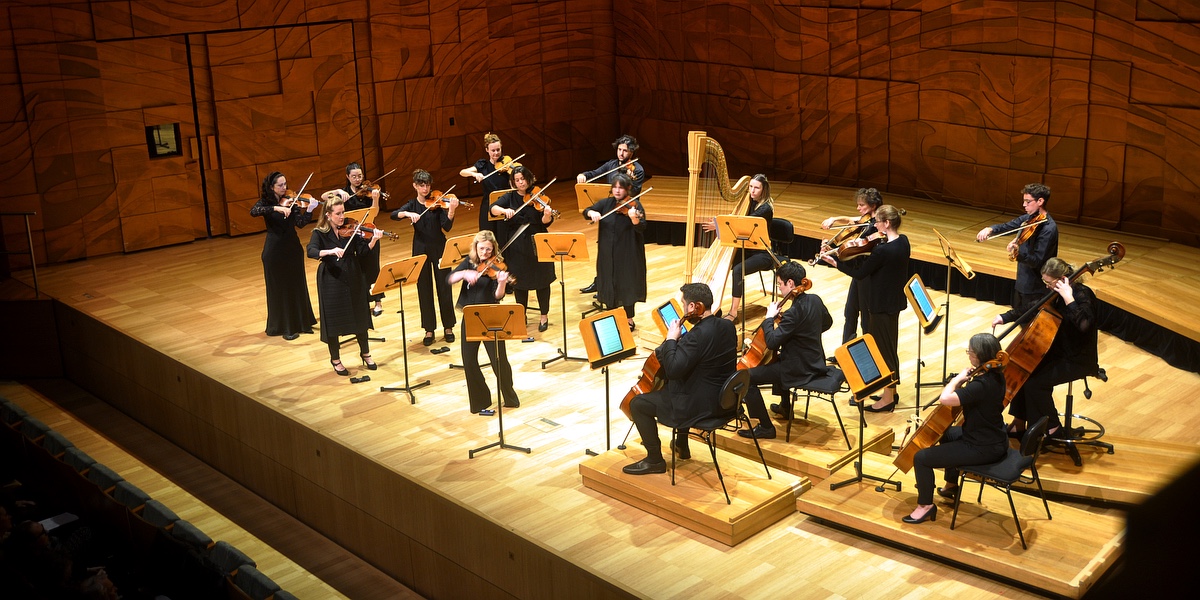
At a time in history when uncertainty and anxiety today make us question the “progress” of man, many of us seek great hope and inspiration in the ongoing beauty and blossoming of the arts. As always, the Melbourne Chamber Orchestra brought us a program of joy with the rejuvenating music of revered classical and Australian composers, performed by a visually appealing ensemble of strings and solo harp, all in the finest acoustic of the Elisabeth Murdoch Hall, AND with post-concert convivial wine and human connecting. And there was more…
MCO Artistic Director Sophie Rowell is a warm and inspiring leader, sharing her love of music, community, and the sheer joy of glorious string music with us. She welcomed guest violinist Alexandra Osborne to lead Beethoven’s Egmont Overture in a special arrangement for string orchestra by Sreten Krstič. Striking energy and an affirmative orchestral tone emanated from Osborne’s performance as she drew out resounding fortissimos in the opening dark minor chords and stormy ensemble surges. Solo conversational themes were finely expressed with hopeful questioning, desire and increasing jubilation. This was a fresh and intelligent heart-warmer that offered a softer tribute to Count Egmont, remembered for his fight against human oppression, music intended by an angry Beethoven to express outrage and rebellion.
Audiences love world premieres, and Sophie Rowell proudly invited a notable and much loved Melbourne composer needing no introduction, Richard Mills, to the stage. Written for Sophie Rowell, Violin Concerto Sinfonia Sacra. Four Portraits of the Blessed Virgin was successfully premiered at Canberra’s International Music Festival on May 31, and tonight’s performance could be summed up with one word: fabulous! Inspired by visual art, Mills was deeply motivated by the journey of the Virgin Mary, the spiritual journey of travel, pilgrimage, epiphany, and wonder. Rowell’s magnificent violin work paired with the heavenly harp of Melina van Leeuwen adding to the most luminous, airy and breezy musical passages. How beautifully constructed and orchestrated were these four “portraits” of Mary.
At the Message of Archangel Gabriel featured solo violin with gorgeous free cadenza-like religious ecstasy, joined by a blended shimmering of harp and gently sustained strings, almost mystical and shadowy under Rowell’s solo. Optimistic rising patterns gave an aura of feminine beauty and dreaminess, the highest notes of the harp making the final heaven-sent message. In The Visit of the Magi, metrical harp pulse beats came with the arrival of the oriental kings, while exotic gypsy scale patterns conjured Middle Eastern flavours and the warmth of the desert. Finely interweaving melodies blended into wondrous harmonies with harp footsteps re-tracing colourful steps as the three Magi departed. This was indeed a truly fabulous score, striking a chord with the audience and inducing at least a few tears.
At the Via Cruci brought us a trembling, low darkness, agitation and anguish with percussive plucked cellos and emotional frenzied and amazing chords underpinning Rowell’s concerto lines. Following high anguished cries in presto agitato, most peaceful themes led us to Mary’s prayer and deepest sorrow at the loss of her son, a solo violin line reinforcing the pathos of a lament, taken to depths over sustained bass strings. Spiritual resolution came with harp notes again rising to the highest string tones. The feeling of Regina Caeli (Queen of Heaven) was gently jubilant, pastorale in nature, and rising contrapuntal themes were most lyrical, joyful, dancing a little, with feminine strength, beauty and growing acceptance. Richard Mills came to the stage to receive huge complimentary applause as he also warmly acknowledged Rowell’s musicianship and high quality performance.
Following Interval, a progression of slow chords of Elegy for String Orchestra (In Memoriam Rupert Brooke) by F. S. Kelly (1881-1916) began a heartfelt, sombre and respectful farewell, a timeless ebb and flow of strength in crescendos and sorrow in diminuendos. Movement and light, memories of life, flowed in many varied patterns of trills. With an apparent simplicity of rhythm throughout, pauses and silences were given prominence.
Much colour and richness emerged from a strong and forward moving Fantasia on a Theme by Thomas Tallis, famously set by Ralph Vaughan Williams. Wearing her hat as MCO Education Officer, bassist Emma Sullivan spoke of an exciting collaboration with students from the Victorian College of the Arts Secondary School, welcoming a large group of young musicians to join a double string orchestra, with MCO section leaders forming an additional third group as a quartet. So popular, lush and with lift and energy, the music flowed with affirmation and confidence, with strong colour and lyricism in the principal Renaissance theme, finally easing to a broad and majestic conclusion. A wide variety of tonal and rhythmic blocks took the performance to an exciting close, with credit too going to Sophie Rowell and violist Merewyn Bramble for pairing with luminous beauty and sensitive leadership.
Strum (2006), by GRAMMY Award winner Jessie Montgomery, closed this substantial program with an intriguing solo viola pattern, plucked and scattered, yet colourfully charming. Strummed pizzicato cross-rhythms and syncopated irregular meters added a folk dance-like character at times. The spotlight was on leaders of each string section as soloists, with double basses especially enjoying their solo moment. Again, a great variety of tone and rhythmic blocks held our attention fully to an exciting rhythmic and accented close.
With more than 50 performances each season, musicians and programming par excellence, MCO concerts are absolutely not to be missed, guaranteed to nourish us at all times.
Photo credit: Catherine Turner
______________________________________________________________
Julie McErlain reviewed “Fantasia”, presented by the Melbourne Chamber Orchestra at the Melbourne Recital Centre on May 1, 2025.